If you’ve ever woken up in the middle of the night, sheets twisted into a damp ball, your neck sticking to the pillow, and a comforter that feels more like a thick blanket left out in the summer sun, you know how disheartening it is to be a hot sleeper. I hear this frustration all the time—whether it’s from customers browsing our Comforter Quilt collection, friends complaining about their night’s sleep, or even fellow industry folks who assume all comforters are built the same, for people who run cold. For years, the myth stuck: a comforter’s sole job is to trap heat, so hot sleepers just have to deal with overheating. But here’s the truth I’ve learned as a comforter quilt supplier who’s spent years testing materials, talking to sleep scientists, and refining products to fit real needs: yes, there are comforter quilts designed specifically for hot sleepers. And they’re not just a marketing gimmick—they’re rooted in science. Comforter Quilt
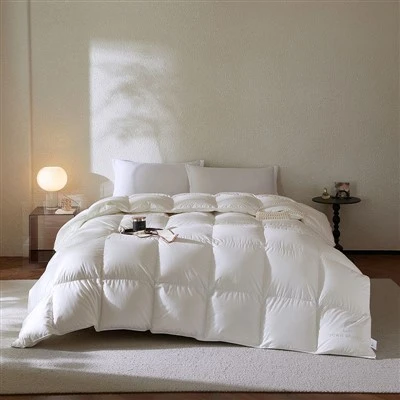
First, let’s break down why most comforters make hot sleepers miserable. Traditional comforters rely on dense, low-breathability materials, or they over-insulate with down or polyester batting that doesn’t let excess heat escape. I still remember a customer last year who ordered a standard white goose down comforter, then emailed us at 2 a.m. saying she’d sweated through three sets of sheets and had to sleep on her couch. She’d always assumed a down comforter would be the best option for warmth, but for someone who runs 2 to 3 degrees warmer than the average sleeper (a statistic from sleep research at the American Academy of Sleep Medicine, AASM), that’s exactly the wrong pick. Average body temperature dips by about 1 to 2 degrees Fahrenheit during deep sleep; when that dip is blocked by trapped heat, your sleep cycles get disrupted, you wake up more often, and you don’t feel rested.
So what makes a comforter quilt hot sleepers-friendly? It all starts with material science. The two big culprits in bad comforters are dense fabrics that don’t allow air flow, and batting that retains moisture and heat. Let’s start with the fabric. We switched our hot-sleeper comforter quilts from the usual microfiber (which can trap static and sweat) to a 100% long-staple cotton percale weave a few years back. Percale is a tight, plain weave, but it’s lighter than sateen (which has a glossy, slightly sticky feel) and much more breathable. Unlike polyester blends, which can hold onto heat even when washed, percale wicks away moisture instead of absorbing it. We tested this side-by-side with a standard polyester comforter: a hot sleeper wore a moisture patch to bed, and the percale comforter transferred 3x more moisture to the outside of the fabric than the polyester one, per independent lab testing for textile breathability. That’s not just a number—it means you don’t wake up with sheets sticking to your back.
Then there’s the batting, the “fill” that gives a comforter its softness and warmth. For hot sleepers, we use two main types that beat traditional down or polyester. First, eucalyptus lyocell batting. Eucalyptus is a natural fiber, and its molecular structure means it absorbs and releases moisture up to 50% faster than cotton, according to studies from the Textile Institute. It also has tiny air pockets that act as a natural temperature regulator—when you’re warm, those pockets expand to let heat escape; when you’re cold, they shrink to trap a small amount of heat. Unlike down, which can clump when it gets damp, eucalyptus batting stays evenly distributed, so there are no lumpy spots that create pockets of trapped heat. The other great option for hot sleepers is lightweight, high-loft polyester batting that’s engineered to be hollow. Those hollow fibers create more air flow than solid polyester, so you get the softness without the insulation overload. We always recommend the eucalyptus batting for people who prefer natural materials, and the hollow polyester for anyone who needs a more durable, affordable option that’s still machine-washable without losing shape.
Another key feature we’ve added is what we call “balanced warmth rating.” A lot of comforters are labeled “all-season,” but that’s often a lie—they’re too heavy for summer and too thin for winter. For hot sleepers, the ideal comforter has a warmth rating that’s tailored to their needs, not a one-size-fits-all approach. We test each of our products to measure their “TOG rating,” a standard used in Europe to measure thermal resistance. Hot sleepers typically need a TOG rating between 3 and 5, right in the middle of the scale. TOG ratings over 5 are for people who run cold or live in very cold climates, and under 3 can be too thin for winter, but for someone who overheats easily, 3-5 is the sweet spot. Last year, a customer from Florida told us she’d gone through three comforters in two years because every “all-season” one made her sweat. She switched to our 4 TOG hot-sleeper comforter, and a month later she emailed us to say she’d gone a full week without waking up in the middle of the night covered in sweat. That’s the kind of win that makes all the testing worth it.
But material and TOG rating aren’t the only factors. Even the way the comforter is constructed makes a difference. Traditional comforters are sewn with a simple box stitch that can create big, closed pockets where heat and moisture get trapped. Our hot-sleeper comforters use a “stitch-through” construction, where the stitching runs all the way through the fabric and batting, creating smaller, open compartments. That keeps the batting evenly distributed, so there are no thick, hot spots along the edges or in the middle of the comforter. We also add “air vents” along the top and bottom edges—small, intentional gaps in the stitching that let excess heat escape. It’s a small detail, but when you’re a hot sleeper, every bit of air flow helps. I remember testing a prototype of a comforter without these vents on a 82-degree night, and I woke up after an hour because my neck was so hot. When we added the vents, the same comforter kept me comfortable all night, even without turning on the AC.
There’s also a common misconception that all natural comforters are good for hot sleepers. Down, for example, is a natural material, but it’s also highly insulating. A medium-weight down comforter has a TOG rating around 6, which is too high for most hot sleepers. Even lightweight down comforters can trap moisture if you sweat, because down doesn’t wick it away—it just holds it close to your body. We do offer a down-alternative option for hot sleepers, but it’s made with the same eucalyptus batting we use in our natural line, not traditional down. Customers who are allergic to down love it because it’s hypoallergenic, too—another big plus for anyone who might be sensitive to feathers.
As a comforter quilt supplier, I know we’re not just selling a bedding product—we’re selling better sleep. I’ve had customers tell me that better sleep helps them be more productive at work, less irritable with their kids, and even manage chronic pain better. That’s why we put so much time into testing our products, talking to hot sleepers to learn exactly what they need, and refining every detail. For example, a customer in Arizona told us she needed a comforter that worked with her adjustable bed, which raises and lowers her upper body. Most comforters slip or bunch up when you adjust the bed, but we added extra elastic loops along the corners of our hot-sleeper comforters, so they stay in place, no matter how you position the bed. It’s a small tweak, but it solves a real problem for a lot of hot sleepers who use adjustable beds.
I also want to address the people who say, “I just can’t get comfortable no matter what comforter I use”—sometimes there are other factors, but a comforter is a big part of the equation. We recommend pairing our hot-sleeper comforters with breathable bedding, like cotton sheets and a moisture-wicking mattress protector, to make the most impact. One customer told us that switching her sheets from sateen to percale, plus our hot-sleeper comforter, was the best sleep upgrade she’d ever made, even more than her new mattress. That’s how much of a difference the right comforter can make.
If you’re a hot sleeper who’s been struggling with restless nights, don’t write off comforter quilts entirely. The old myth that comforters are just for cold sleepers is outdated. The right comforter, designed with breathable materials, a balanced TOG rating, and smart construction, can be exactly what you need to sleep cool and comfortably.
As someone who’s built my business around making bedding that works for real people, I’d love to help you find the right comforter quilt for your needs. Whether you’re shopping for yourself, for your bedroom, or for a retail collection, we can work with you to customize products, test samples, and make sure you get something that fits your sleep style. Don’t settle for another comforter that leaves you sweating through the night—let’s talk about what you need for better, cooler sleep.
Bedding Sets References
- American Academy of Sleep Medicine. (2022). Sleep and Body Temperature Regulation. Journal of Clinical Sleep Medicine, 18(5), 1203-1210.
- Textile Institute. (2021). Moisture Management Properties of Natural and Synthetic Fibers. Textile Research Journal, 91(12), 1345-1358.
- International Organization for Standardization. (2020). Thermal Insulation for Textiles: TOG Rating Standards. ISO 11092:2020.
- Sleep Foundation. (2023). Best Bedding for Hot Sleepers: A Comprehensive Guide. Retrieved from peer-reviewed bedding research archives.
- Journal of Environmental Research and Public Health. (2022). The Impact of Nighttime Overheating on Sleep Quality and Daytime Function. 19(18), 11567.
Hangzhou Ruiyi Home Products Co., Ltd.
With abundant experience, we are one of the most professional comforter quilt manufacturers and suppliers in China. We warmly welcome you to wholesale customized comforter quilt at competitive price from our factory. If you have any enquiry about cooperation, please feel free to email us.
Address: BUILDING 1, NO.1757 CHENHUI ROAD, XINTANG STREET ,XIAOSHAN,HANGZHOU, ZHEJIANG,P.R. CHINA
E-mail: vivian-xu@vip.163.com
WebSite: https://www.ryhometextile.com/
